Harmonic Distortion
What is Harmonic Distortion?
Harmonic distortion is the alteration of an electrical voltage or current waveform caused by the presence of harmonic frequencies in addition to the fundamental frequency. These harmonics occur at integer multiples of the fundamental frequency and can cause the waveform to deviate from its ideal sinusoidal shape.
In electrical power systems, harmonic distortion is commonly associated with nonlinear loads such as switch mode power supplies (SMPS), variable frequency drives, LED drivers and other electronic equipment.
Excessive harmonic distortion can increase electrical losses, cause additional heating, interfere with sensitive equipment and reduce overall power quality.
How Harmonic Distortion Works
In an ideal AC power system, voltage and current waveforms are sinusoidal, operating at a fundamental frequency of 50Hz in the UK and most of Europe, or 60Hz in regions such as North America.
Harmonics are generated when electrical equipment draws current in a nonlinear manner, meaning the current does not follow the applied voltage proportionally.
For example, in a 50Hz electrical system, harmonic frequencies include:
1st harmonic (fundamental frequency): 50Hz
2nd harmonic: 100Hz
3rd harmonic: 150Hz
5th harmonic: 250Hz
7th harmonic: 350Hz
These additional frequency components combine with the fundamental waveform, producing a distorted current or voltage shape.
The amount and type of distortion depend on the equipment, its operating conditions and the electrical network to which it is connected.
What Causes Harmonic Distortion?
Harmonic distortion is primarily caused by nonlinear electrical loads that draw current in pulses or other nonsinusoidal patterns.
Switch Mode Power Supplies
Switch mode power supplies commonly rectify incoming AC voltage and use capacitors to smooth the resulting DC.
Without suitable power factor correction, the input capacitors may draw short pulses of current near the peaks of the AC waveform.
These current pulses contain harmonic components that contribute to distortion on the electrical supply network.
LED Drivers
LED drivers convert AC mains voltage into regulated DC power suitable for LED lighting.
Depending on their circuit design, they may draw nonsinusoidal input current, generating harmonics.
In commercial and industrial installations containing large numbers of LED luminaires, the combined harmonic contribution may become significant.
Variable Frequency Drives
Variable frequency drives (VFDs) use power electronic converters to control the speed of electric motors.
Their input rectifier stages can generate harmonic currents, particularly when conventional diode rectifiers are used without appropriate mitigation.
Other Nonlinear Loads
Additional sources include:
Computers and servers
Battery chargers
Uninterruptible power supplies (UPS)
Electronic lighting equipment
Industrial rectifiers
Welding equipment
Power electronic converters
The harmonic contribution of each device depends on its design, loading and operating conditions.
Types of Harmonic Distortion
Harmonic distortion in electrical systems is generally divided into two categories.
Current Harmonic Distortion
Current harmonic distortion occurs when a load draws nonsinusoidal current from an AC source.
This is particularly common in electronic equipment containing rectifiers and switching circuits.
Harmonic currents flowing through the impedance of the electrical distribution system can produce additional voltage drops and contribute to voltage distortion.
Voltage Harmonic Distortion
Voltage harmonic distortion occurs when the supply voltage waveform deviates from an ideal sine wave.
It is often caused by harmonic currents flowing through the impedance of transformers, cables and other distribution components.
Voltage distortion can affect other equipment connected to the same electrical network, even if that equipment does not generate significant harmonics itself.
Total Harmonic Distortion (THD)
Total Harmonic Distortion, commonly abbreviated to THD, is a measurement used to quantify the combined contribution of harmonic frequencies relative to the fundamental frequency.
It is normally expressed as a percentage.
For voltage, THD is calculated using:
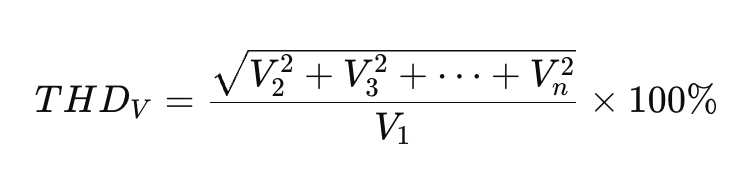
Where:
V1= RMS voltage of the fundamental frequency
V2, V3, ..., Vn = RMS voltages of the individual harmonic components
The same principle applies to current harmonic distortion, using the corresponding current values.
A lower THD percentage indicates that the waveform contains fewer harmonics relative to its fundamental component.
Example of Harmonic Distortion
Consider a 50Hz electrical supply containing a fundamental voltage of 230V RMS and a fifth harmonic component of 11.5V RMS.
If no other harmonics are present, the total harmonic distortion is:
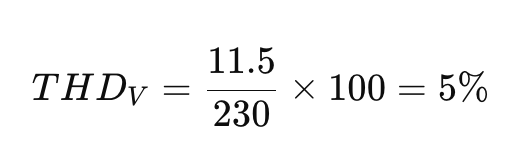
This means the fifth harmonic component has an RMS magnitude equal to 5% of the fundamental voltage.
THD describes waveform distortion, but it does not independently indicate whether a power supply complies with applicable harmonic emission limits.
Effects of Harmonic Distortion
Excessive harmonic distortion can affect both electrical distribution systems and connected equipment.
Increased Heating
Harmonic currents contribute to additional losses in cables, transformers, motors and other electrical components.
These losses can increase operating temperatures and potentially reduce equipment lifespan.
Reduced Power Quality
Harmonic currents can distort the supply voltage, particularly where the electrical network has relatively high impedance.
This may affect the performance of equipment that depends on a stable, low-distortion voltage supply.
Neutral Conductor Overloading
In three-phase systems, certain harmonic currents, particularly third-order harmonics and their odd multiples, can add together in the neutral conductor rather than cancelling.
Where these harmonics are significant, the neutral conductor may carry more current than expected.
Interference with Electronic Equipment
Harmonic distortion can contribute to operational problems in sensitive electrical and electronic equipment, including measurement errors and control system disturbances.
Reduced System Efficiency
Additional harmonic currents can increase electrical losses without contributing useful power at the fundamental frequency.
This can reduce the overall efficiency of electrical distribution systems.
Harmonic Distortion and Power Factor
Harmonic distortion and power factor are closely related, but they describe different electrical characteristics.
Power factor is the ratio of real power to apparent power in an AC electrical system.
For sinusoidal voltage and current, power factor depends on the phase difference between them.
However, when current is distorted by harmonics, the true power factor is also affected by the waveform shape.
A power supply may therefore have a relatively small phase difference between its fundamental voltage and current while still exhibiting a reduced true power factor due to harmonic distortion.
This is why modern power supplies often incorporate power factor correction circuitry.
How to Reduce Harmonic Distortion
Several techniques can be used to reduce harmonic currents and improve electrical power quality.
Power Factor Correction (PFC)
Power factor correction circuits are widely used in modern AC/DC power supplies.
Active PFC circuits control the input current so that it more closely follows the sinusoidal input voltage.
This reduces harmonic current distortion and can improve the true power factor.
Passive PFC uses inductors, capacitors or other passive components to modify the input current waveform.
Harmonic Filters
Harmonic filters are designed to attenuate unwanted harmonic frequencies.
These may include:
Passive harmonic filters
Active harmonic filters
Tuned LC filters
Line reactors
The appropriate filtering method depends on the harmonic frequencies, load characteristics and electrical installation.
Improved Power Supply Design
Modern power conversion circuits can reduce harmonic emissions through improved rectifier arrangements, switching control and input current shaping.
Appropriate System Design
In larger electrical installations, harmonic mitigation may involve selecting low-distortion equipment, evaluating transformer loading and considering the combined effect of multiple nonlinear loads.
Harmonic Distortion in LED Drivers
Harmonic distortion is an important consideration when selecting LED drivers for commercial and industrial lighting installations.
LED drivers frequently incorporate rectification and switching circuitry, which can generate harmonic currents.
When many luminaires are connected to the same electrical distribution system, their combined harmonic emissions may affect power quality.
Drivers with suitable power factor correction circuitry can help reduce these effects.
However, a high power factor does not automatically guarantee compliance with every applicable harmonic emission requirement.
Both power factor and harmonic current performance should be considered when selecting LED drivers.
Harmonic Distortion Standards
Harmonic emissions from electrical and electronic equipment are addressed by international standards.
Two commonly referenced standards are:
IEC/EN 61000-3-2
This standard specifies limits for harmonic current emissions from equipment with input currents of up to and including 16A per phase, within its defined scope.
It includes requirements for different equipment classifications, including applicable lighting equipment.
IEC/EN 61000-3-12
This standard addresses harmonic current emissions from equipment with rated input currents greater than 16A and up to and including 75A per phase, under specified conditions.
Compliance requirements depend on the equipment classification, intended connection and applicable regulations.
Manufacturers should evaluate their products against the relevant standards for their intended markets.
Why Harmonic Distortion Matters in Power Supplies
Harmonic distortion is an important consideration in the design and selection of AC/DC power supplies.
Excessive harmonic currents can increase losses, reduce power quality and affect other equipment connected to the same electrical system.
Understanding harmonic distortion helps engineers select appropriate power supplies, evaluate power factor correction requirements and design electrical installations that operate reliably.
For industrial power supplies, LED drivers and other electronic equipment, harmonic performance should be considered alongside efficiency, power factor, electromagnetic compatibility and applicable safety requirements.
People Also Ask
What is harmonic distortion in simple terms?
Harmonic distortion occurs when additional frequency components alter the shape of an electrical voltage or current waveform, causing it to deviate from an ideal sine wave.
What causes harmonic distortion in power supplies?
Harmonic distortion is commonly caused by nonlinear input circuits, such as rectifiers and capacitors, which draw current in pulses rather than following the sinusoidal AC voltage.
What is the difference between harmonics and total harmonic distortion?
Harmonics are individual frequency components occurring at integer multiples of the fundamental frequency. Total Harmonic Distortion (THD) measures their combined RMS magnitude relative to the fundamental.
How does harmonic distortion affect power factor?
Harmonic current distortion can reduce the true power factor of an electrical system, even when the fundamental current is closely aligned with the supply voltage.
How can harmonic distortion be reduced?
Harmonic distortion can be reduced through active power factor correction, passive or active harmonic filters, line reactors and improved power conversion circuit designs.
What is an acceptable level of harmonic distortion?
Acceptable harmonic distortion depends on the equipment, installation and applicable standards. Equipment harmonic emission standards, such as IEC/EN 61000-3-2, specify limits for individual harmonic currents rather than one universal THD percentage.
Speak to a technical expert!
Have a question or request? Click below to contact us, and our team will be happy to help.