Crowbar Protection
What is Crowbar Protection?
Crowbar protection is a fail-safe protection method that protects a power supply or connected load from overvoltage. It works by deliberately short-circuiting the output when the voltage rises above a safe limit, causing a fuse, circuit breaker or protection circuit to disconnect the supply.
The name comes from the idea of placing a metal crowbar across the output terminals to create a short circuit.
Why Crowbar Protection Matters
Overvoltage can damage sensitive electronic equipment very quickly. Crowbar protection helps prevent this by forcing the system into a safe fault condition before the excess voltage reaches the load for too long.
It is commonly used to protect:
- Sensitive electronic circuits
- Low-voltage power supply outputs
- Industrial control systems
- Expensive or safety-critical loads
How Crowbar Protection Works
A crowbar circuit is usually placed across the output of a power supply. It monitors the output voltage and compares it against a preset threshold.
If the voltage exceeds that threshold:
- The crowbar device is triggered
- The output is short-circuited
- A fuse blows, circuit breaker trips or protection system shuts down
- Power is removed from the load
This prevents the connected equipment from being exposed to damaging voltage levels.
Crowbar Protection Circuit Example
Place your image here, directly under this heading.
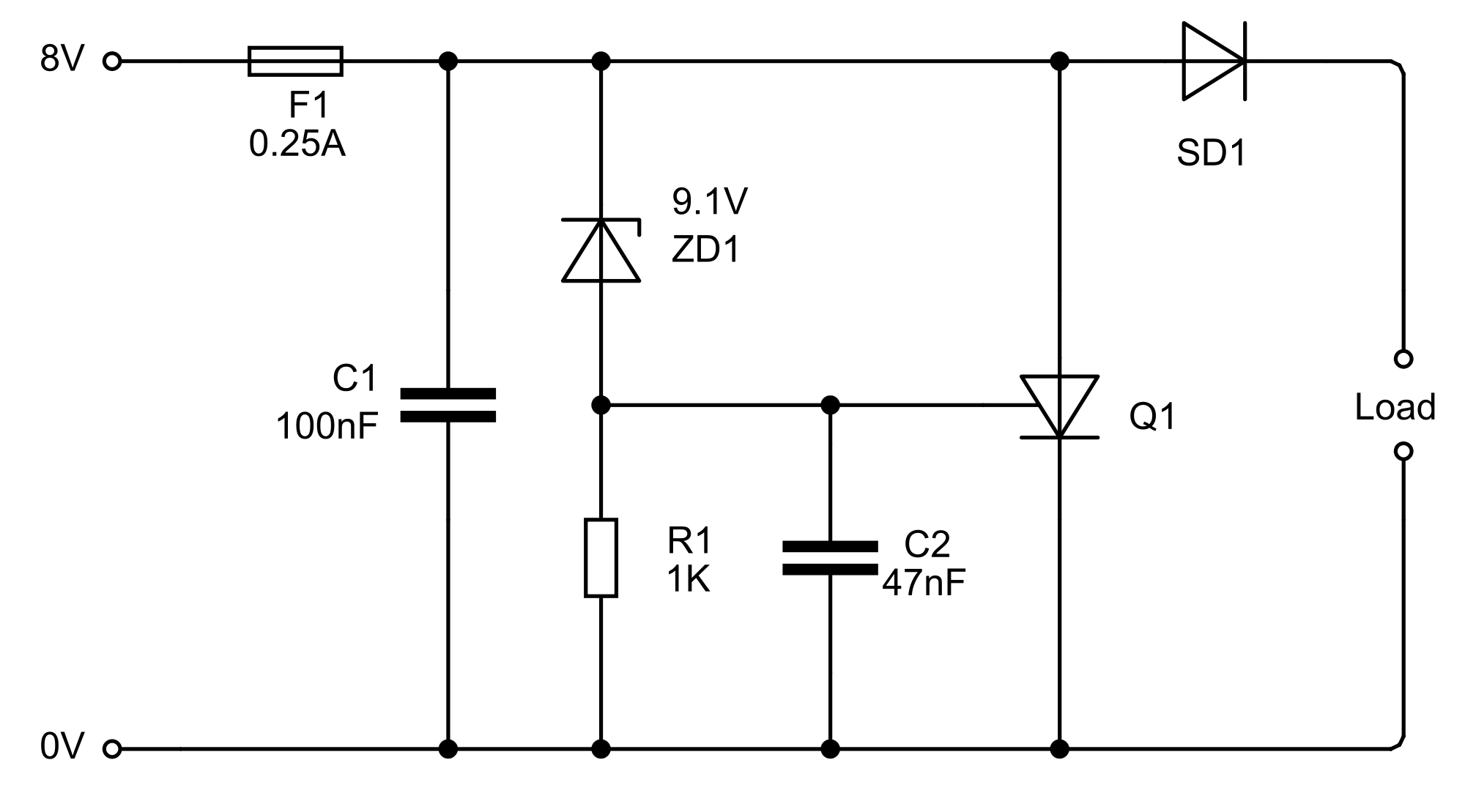
The example circuit uses an 8V supply with overvoltage protection set around 9.1V. If the output voltage reaches the zener diode threshold, the zener begins to conduct and triggers the thyristor. The thyristor then creates a short circuit, causing the fuse to open and disconnect the supply.
Common Crowbar Components
Crowbar protection circuits commonly use:
- Zener diodes for voltage sensing
- Thyristors or SCRs for short-circuit triggering
- Fuses or circuit breakers for disconnection
- MOSFETs in some modern active protection designs
The exact design depends on the required response time, voltage level and sensitivity of the protected equipment.
Passive vs Active Crowbar Protection
Traditional crowbar protection often relies on a fuse or breaker being triggered by the short circuit. Once activated, the fuse may need to be replaced before the system can operate again.
Active crowbar protection can remove the short after the transient or fault condition has passed, allowing the system to recover without replacing a fuse. These designs may use devices such as MOSFETs, gate turn-off thyristors or other controllable switching components.
Advantages of Crowbar Protection
Crowbar protection is widely used because it is:
- Simple and cost-effective
- Fast acting
- Effective against overvoltage faults
- Useful for protecting sensitive loads
- Capable of forcing a clear fault condition
It can also make faults obvious by blowing a fuse or tripping a circuit breaker.
Limitations of Crowbar Protection
Although effective, crowbar protection must be designed carefully. Because it deliberately creates a short circuit, the system must include suitable current limiting or disconnection protection.
Key considerations include:
- Fuse or breaker rating
- Trigger voltage accuracy
- Crowbar device current rating
- Response time
- Load sensitivity
Poorly designed crowbar protection can cause unnecessary shutdowns or place stress on the power supply.
Where Crowbar Protection Is Used
Crowbar protection is used in:
- AC-DC power supplies
- DC power systems
- Industrial electronics
- Test and measurement equipment
- Sensitive low-voltage circuits
It is especially useful where overvoltage could cause immediate or costly damage.
People Also Ask
What does crowbar protection do?
Crowbar protection short-circuits the output of a power supply during an overvoltage fault, forcing a fuse, breaker or protection circuit to disconnect the supply.
Why is it called crowbar protection?
It is called crowbar protection because it behaves like placing a metal crowbar across the output terminals, creating a deliberate short circuit.
What triggers a crowbar circuit?
A crowbar circuit is usually triggered when the output voltage exceeds a preset threshold, often detected using a zener diode or sensing circuit.
What is the difference between crowbar protection and overvoltage protection?
Crowbar protection is one type of overvoltage protection. It responds by shorting the output, while other overvoltage protection methods may shut down, clamp or limit the voltage.
Does crowbar protection damage the power supply?
It should not damage the system if designed correctly, but it does create a high-current fault path, so proper fusing, current limiting and component ratings are essential.
Speak to a technical expert!
Have a question or request? Click below to contact us, and our team will be happy to help.