Capacitive Coupling
What is Capacitive Coupling?
Capacitive coupling is a method of transferring alternating current (AC) signals between two circuits using a capacitor, while blocking direct current (DC). It allows signal transmission without directly connecting the circuits electrically.
This technique is widely used in electronic systems to isolate DC bias while allowing useful AC signals to pass.
How Capacitive Coupling Works
A capacitor placed between two circuits acts as a bridge for AC signals. It allows changing signals to pass through while preventing steady DC voltage from flowing.
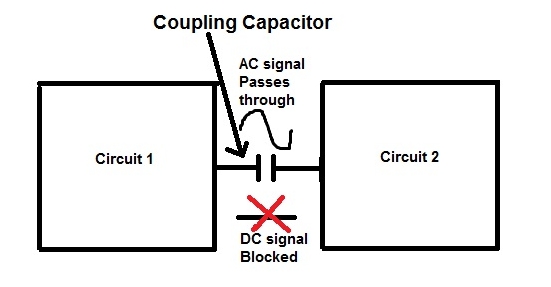
This behaviour occurs because:
- Capacitors have low impedance to AC signals
- Capacitors block DC after charging
Why Capacitive Coupling Is Used
Capacitive coupling is important because it:
- Isolates DC bias between circuit stages
- Allows signal transfer without direct electrical connection
- Prevents unwanted DC from affecting other parts of the circuit
- Helps maintain signal integrity
Choosing a Coupling Capacitor
The performance of capacitive coupling depends on the capacitor used.
Key factors include:
- Capacitance value, which determines frequency response
- Voltage rating, which must match the circuit
- Type of capacitor, such as film or electrolytic
Non-polar capacitors like polyester or polypropylene are commonly used, although electrolytic capacitors may be used in cost-sensitive applications.
Capacitive Coupling in Analog Circuits
In analog systems, coupling capacitors are used to:
- Pass audio or signal frequencies between amplifier stages
- Block DC bias voltages
- Maintain correct operating conditions for each stage
Capacitive Coupling in Digital Circuits
In digital systems, capacitive coupling is used for:
- Transmitting AC-balanced signals
- Removing DC offsets
- Supporting high-speed signal transmission
Parasitic Capacitive Coupling
Capacitive coupling can also occur unintentionally.
Parasitic coupling happens when:
- PCB traces are too close together
- Wires run in parallel
- Signals interfere with each other
This can introduce noise and unwanted signal transfer.
To reduce this:
- Increase spacing between conductors
- Use grounding techniques
- Add shielding where necessary
Gimmick Coupling
A simple form of capacitive coupling can be created using two closely spaced wires. This produces a very small capacitance and is sometimes used in RF or experimental circuits.
Where Capacitive Coupling Is Used
Common applications include:
- Audio and amplifier circuits
- Digital communication systems
- Telecommunication equipment
- Filter and crossover circuits
- Power supply signal paths
People Also Ask
What is capacitive coupling in simple terms?
Capacitive coupling is a method of passing AC signals between circuits using a capacitor while blocking DC voltage.
Why does a capacitor block DC?
A capacitor blocks DC because it charges up and then prevents further current flow, while still allowing changing AC signals to pass.
What is the difference between AC coupling and DC coupling?
AC coupling uses capacitors to block DC and pass signals, while DC coupling allows both AC and DC signals to pass directly.
What causes parasitic capacitive coupling?
It is caused by unwanted capacitance between nearby conductors such as PCB traces or wires, leading to noise or interference.
Where is capacitive coupling used?
It is used in audio circuits, communication systems, filters and power supply designs to isolate signals and block DC.
Speak to a technical expert!
Have a question or request? Click below to contact us, and our team will be happy to help.