Current Sharing
What is Current Sharing in Power Supplies?
Current sharing is a technique where two or more power supplies are connected in parallel so they can collectively supply current to a load while maintaining the same output voltage.
This method is commonly used to:
- Increase available load current
- Improve redundancy and fault tolerance
- Reduce stress on individual power supplies
Current sharing is widely used in industrial systems, telecommunications equipment, servers and high-power electronic applications.
Why Current Sharing Is Used
A single power supply may not always provide enough output current for an application. By connecting supplies in parallel, the system can deliver higher total current while distributing the load across multiple modules.
Current sharing also improves:
- System reliability
- Power redundancy
- Thermal performance
- Overall lifespan of the power supplies
How Current Sharing Works
When power supplies are connected in parallel, they must share the load proportionally to avoid overloading one unit.
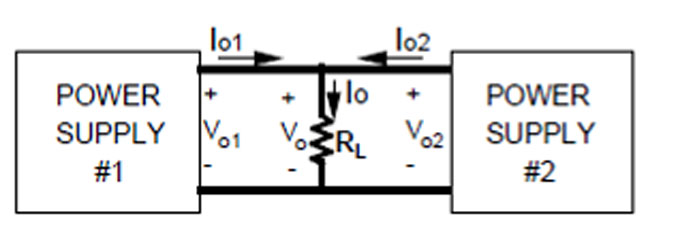
A current sharing system typically includes:
- Current balancing circuitry
- Output isolation methods such as ORing diodes
- Feedback control mechanisms
Without proper sharing control:
- One supply may deliver most of the current
- Other units may contribute less
- Overheating or overload conditions may occur
ORing Diodes in Current Sharing
ORing diodes are commonly used to:
- Prevent reverse current flow between supplies
- Isolate failed modules
- Improve redundancy and fault tolerance
This ensures one failed supply does not affect the others.
Current Sharing Methods
There are three main current sharing methods used in power supplies.
1. Brute-Force Current Sharing
Brute-force sharing is the simplest method, where supplies are connected directly in parallel without active balancing circuitry.
Advantages
- Simple and inexpensive
- Scalable
- Can use standard power supplies
Disadvantages
- Poor load balancing
- Risk of overstressing one supply
- Requires closely matched output voltages and wiring
2. Forced Current Sharing
Forced or active current sharing uses control circuitry and communication between supplies to balance load current accurately.
A third wire is often used for sharing information between modules.
Advantages
- Excellent load balancing
- Accurate voltage regulation
- Good scalability
- Supports remote sensing
Disadvantages
- More complex and expensive
- May require matching supply models
- Additional circuitry may be needed for noise reduction
3. Zero-Wire Current Sharing
Zero-wire sharing, also called passive sharing, droop sharing or slope programming, adjusts output voltage based on load current.
As current increases:
- Output voltage decreases slightly
- Load naturally balances between supplies
Advantages
- Simple and reliable
- No extra sharing wire required
- Good scalability
Disadvantages
- Lower voltage regulation accuracy
- Typically around ±2% regulation
Current Sharing and Reliability
Current sharing allows each supply to operate below maximum capacity, a process known as derating.
This helps:
- Reduce thermal stress
- Improve reliability
- Extend operational lifespan
It also keeps all power modules active rather than leaving backup supplies idle.
Applications of Current Sharing
Current sharing is commonly used in:
- Industrial power systems
- Telecommunications equipment
- Server and data centre power supplies
- Medical systems
- Redundant power architectures
It is especially important in systems requiring continuous operation.
People Also Ask
What is current sharing in power supplies?
Current sharing is the process of connecting multiple power supplies in parallel so they can collectively supply current to a load.
Why is current sharing important?
It increases available current, improves redundancy and reduces stress on individual power supplies.
What are ORing diodes used for in current sharing?
ORing diodes prevent reverse current flow and isolate failed power supplies in parallel systems.
What is active current sharing?
Active current sharing uses control circuitry and feedback to distribute current evenly between power supplies.
What is droop sharing?
Droop sharing is a passive current sharing method where output voltage decreases slightly as load current increases, helping balance the load naturally.
Speak to a technical expert!
Have a question or request? Click below to contact us, and our team will be happy to help.