Equivalent Series Resistance
What is Equivalent Series Resistance (ESR)?
Equivalent Series Resistance (ESR) is the small internal resistance that appears in series with a capacitor. Although capacitors are intended to store and release electrical energy efficiently, all real capacitors contain some unavoidable internal resistance.
ESR affects:
- Efficiency
- Ripple voltage
- Heat generation
- Stability
- Power supply performance
In high-frequency and high-current applications such as switch mode power supplies (SMPS), ESR becomes especially important.
How ESR Works
A real capacitor is not ideal. In addition to capacitance, it contains internal resistive elements caused by:
- Conductive materials
- Electrolyte resistance
- Dielectric losses
- Internal connections
This resistance behaves as though it were connected in series with the capacitor itself.
Higher ESR causes:
- More heat
- Higher ripple voltage
- Greater power loss
- Reduced efficiency
Why ESR Matters in Power Supplies
In power supplies, capacitors are commonly used for:
- Filtering
- Smoothing
- Energy storage
- Ripple reduction
If ESR is too high:
- Ripple voltage increases
- Capacitors heat up more
- Efficiency decreases
- Stability problems may occur
Low ESR is therefore essential in many modern high-frequency power circuits.
Capacitor Types and ESR
Different capacitor technologies have different ESR characteristics.
1. Higher ESR Capacitors
- Aluminium electrolytic capacitors
- Some tantalum capacitors
2. Lower ESR Capacitors
- Multilayer ceramic capacitors (MLCC)
- Solid polymer capacitors
- Special low ESR capacitors
Film capacitors often fall between these categories.
Main Causes of ESR
ESR is mainly caused by:
- Metallic resistance inside the capacitor
- Electrolyte resistance
- Dielectric losses
- Internal contact resistance
The exact ESR value depends on:
- Capacitor construction
- Frequency
- Temperature
- Ageing
- Component quality
What Increases ESR?
Several factors can increase ESR over time.
1. Electrolyte Drying
Electrolytic capacitors gradually dry out at elevated temperatures, increasing resistance.
2. Poor Internal Connections
Mechanical crimps and welds inside the capacitor contribute small resistive losses.
3. High Temperature Stress
Excessive heat increases internal losses and accelerates ageing.
4. Frequency Effects
ESR changes significantly with operating frequency.
ESR and Frequency
The ESR of a capacitor changes with frequency due to:
- Dielectric losses
- Leakage losses
- Skin effect
- Contact resistance
At lower frequencies, dielectric and leakage effects dominate. At higher frequencies, conductor and contact resistance become more significant.
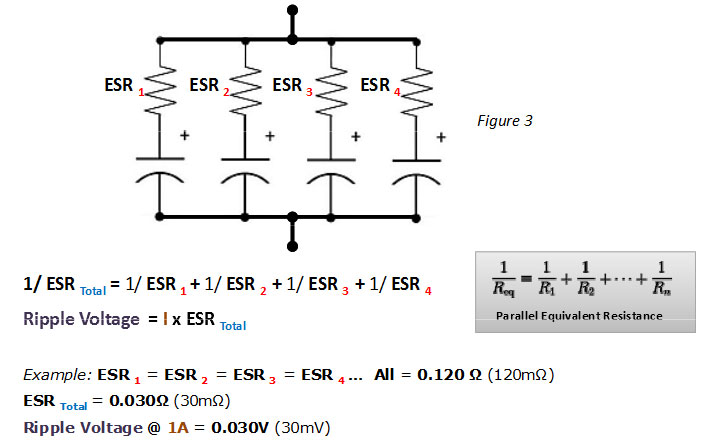
Reducing ESR in Circuits
One common method of reducing ESR is connecting capacitors in parallel.
When capacitors are connected in parallel:
- Total ESR decreases
- Ripple current capability increases
- Ripple voltage decreases
Smaller capacitors in parallel often perform better than a single large capacitor in high-frequency applications.
ESR and Ripple Voltage
Ripple voltage is strongly affected by ESR.
The ripple voltage generated by capacitor ESR can be estimated using:
Where:
- = Ripple current
- = Equivalent Series Resistance
Lower ESR helps minimise ripple voltage in power supplies.
Calculating Capacitor Impedance
Capacitor impedance changes with frequency and capacitance.
The capacitive reactance is given by:
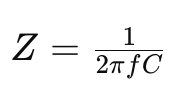
Where:
- f = Frequency
- C = Capacitance
ESR and Dissipation Factor
Sometimes manufacturers specify Dissipation Factor (DF) instead of ESR.
In these cases:
ESR=DF×Z
Where:
- DF = Dissipation factor
- Z = Capacitor impedance
This helps estimate ESR across different frequencies.
Measuring ESR
ESR meters are used to measure capacitor ESR either:
- In-circuit
- Out-of-circuit
Measurements are commonly specified at:
- 120Hz
- 100kHz
depending on capacitor type and application.
Advantages of Low ESR Capacitors
Low ESR capacitors provide several benefits:
- Lower power losses
- Reduced heat generation
- Better ripple filtering
- Improved power supply stability
- Higher efficiency
- Improved high-frequency performance
This makes them ideal for:
- SMPS circuits
- Motherboards
- DC-DC converters
- LED drivers
- Industrial electronics
People Also Ask
What does ESR mean in a capacitor?
ESR stands for Equivalent Series Resistance, which is the internal resistance present inside a capacitor.
Why is ESR important?
High ESR increases heat, ripple voltage and power loss, reducing efficiency and stability.
What causes ESR in capacitors?
ESR is caused by internal conductive resistance, dielectric losses, electrolyte resistance and contact resistance.
Why are low ESR capacitors used in power supplies?
Low ESR capacitors reduce ripple voltage, improve efficiency and enhance stability in high-frequency circuits.
Does ESR increase with age?
Yes, especially in electrolytic capacitors where electrolyte drying increases internal resistance over time.
Speak to a technical expert!
Have a question or request? Click below to contact us, and our team will be happy to help.