Vibration Rating
What is a Vibration Rating?
A vibration rating indicates the level of mechanical vibration that electrical or electronic equipment is designed or tested to withstand under specified conditions.
In industrial power supplies, vibration resistance is commonly expressed using acceleration values such as 3G, 5G or 10G, together with a test frequency range and other operating conditions.
Vibration ratings help engineers determine whether equipment is suitable for applications involving machinery, motors, transportation systems or other environments where continuous or intermittent mechanical vibration may occur.
However, a vibration rating must be interpreted alongside the relevant testing standard, frequency range, duration and mounting conditions. A value such as 3G does not, by itself, fully describe a product's vibration resistance.
What Does G Mean in a Vibration Rating?
In vibration testing, G refers to acceleration expressed as a multiple of standard gravitational acceleration.
One G is approximately equal to 9.81 metres per second squared (m/s²).
For example:
| Vibration rating | Acceleration |
| 1G | 9.81 m/s² |
| 3G | 29.43 m/s² |
| 5G | 49.05 m/s² |
| 10G | 98.10 m/s² |
A 3G vibration rating therefore corresponds to an acceleration magnitude three times standard gravitational acceleration.
In sinusoidal vibration testing, this value commonly represents the peak acceleration applied during the specified test.
It does not mean the equipment continuously experiences a force equal to three times its weight, nor does it describe the complete vibration environment.
The actual mechanical stress depends on vibration frequency, displacement, mounting arrangement and the equipment's structural characteristics.
How Is Vibration Resistance Measured?
Vibration testing uses specialised equipment to apply controlled mechanical movement to a product.
The equipment is typically mounted to a vibration test system, often called a shaker, which produces vibration according to a defined test profile.
During testing, engineers may monitor the equipment's operation, structural integrity and electrical performance.
The main test parameters include:
Vibration Frequency
Frequency describes how many vibration cycles occur per second and is measured in hertz (Hz).
For example, a vibration test may specify a frequency range of 10Hz to 500Hz.
Different frequencies can affect equipment differently, particularly when they approach the natural resonant frequencies of mechanical components.
Acceleration
Acceleration describes how rapidly the vibration velocity changes.
It is commonly expressed in G or m/s².
Higher acceleration values generally indicate more severe vibration conditions when other test parameters are comparable.
Displacement
Displacement describes the distance an object moves from its reference position during vibration.
It is commonly expressed in millimetres.
In sinusoidal vibration testing, displacement and acceleration are related through vibration frequency.
Test Duration
Test duration specifies how long the equipment is exposed to vibration.
A product may be tested for a defined period along each axis or through a specified number of frequency sweeps.
Test Direction
Vibration may be applied along three perpendicular axes, commonly identified as X, Y and Z.
Testing multiple axes helps evaluate how the equipment responds to vibration in different directions.
What Does a 3G Vibration Rating Mean?
A 3G vibration rating indicates that equipment has been specified or tested to withstand vibration acceleration of three times standard gravitational acceleration under defined conditions.
For example, an industrial power supply datasheet may specify:
Vibration: 10–500Hz, 3G, 10 minutes/cycle, 60 minutes each along X, Y and Z axes.
This describes a sinusoidal vibration test involving:
A frequency range from 10Hz to 500Hz
A specified acceleration level of 3G
A defined frequency sweep cycle
Testing along three perpendicular axes
A specified duration for each axis
The exact interpretation must follow the manufacturer's test specification, including any displacement-controlled portions of the test.
A 3G rating does not necessarily mean the equipment can withstand every vibration environment with acceleration below 3G.
The operating frequency, resonance characteristics, mounting method and duration must also be considered.
3G vs 5G vs 10G Vibration Ratings
Different vibration ratings are used to describe equipment designed for different mechanical environments.
| Rating | Acceleration | General interpretation |
| 3G | 29.43 m/s² | Commonly specified for industrial electronic equipment |
| 5G | 49.05 m/s² | Higher vibration acceleration capability |
| 10G | 98.10 m/s² | Often associated with more demanding vibration environments |
A higher G rating indicates a higher specified acceleration level, but it does not automatically mean a product is more durable in every application.
For example, a power supply tested at 5G over one frequency range cannot necessarily be considered more vibration-resistant than a product tested at 3G over a different range or duration.
Meaningful comparisons require equivalent test conditions.
The test standard, frequency range, acceleration profile, duration and mounting arrangement should all be reviewed.
Why Vibration Frequency Matters
Vibration frequency has a significant influence on the mechanical stress experienced by electronic equipment.
At lower frequencies, vibration may involve relatively large physical movement.
At higher frequencies, displacement may be smaller while acceleration remains substantial.
For sinusoidal vibration, peak acceleration is related to peak displacement and frequency by:
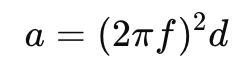
Where:
a = Peak acceleration in m/s²
f = Vibration frequency in Hz
d = Peak displacement in metres
This relationship demonstrates why vibration acceleration cannot be evaluated independently of frequency and displacement.
Mechanical Resonance
Mechanical components have natural frequencies at which they tend to vibrate more strongly.
When an external vibration frequency approaches a component's natural frequency, resonance may amplify its movement and mechanical stress.
In electronic equipment, resonance can affect:
PCB assemblies
Transformers and inductors
Connectors
Mounting brackets
Heat sinks
Internal wiring
Vibration testing helps identify potential weaknesses associated with these conditions.
IEC 60068-2-6 Vibration Testing
IEC 60068-2-6 is an international standard that specifies methods for testing equipment under sinusoidal vibration.
It forms part of the IEC 60068 series of environmental testing standards.
The standard provides procedures for evaluating how products respond to vibration at specified frequencies, amplitudes and durations.
Testing may be used to identify mechanical weaknesses, deterioration in performance or structural damage.
What Does IEC 60068-2-6 Cover?
The standard addresses aspects of sinusoidal vibration testing, including:
Test equipment and mounting arrangements
Frequency ranges
Vibration amplitude
Frequency sweeping
Test duration
Testing along different axes
Examination of equipment before and after testing
IEC 60068-2-6 does not assign a universal 3G, 5G or 10G pass rating to all equipment.
Instead, the applicable product specification defines the test severity and acceptance criteria.
A manufacturer's claim of compliance should therefore be considered alongside the stated test conditions.
Sinusoidal vs Random Vibration Testing
Not all mechanical vibration follows a regular repeating pattern.
Two common vibration testing methods are sinusoidal and random vibration testing.
Sinusoidal Vibration
Sinusoidal vibration follows a repeating waveform at a defined frequency.
During testing, the frequency may be swept through a specified range to evaluate equipment behaviour and identify resonances.
Sinusoidal vibration is commonly associated with IEC 60068-2-6.
Random Vibration
Random vibration contains a range of frequencies occurring simultaneously with varying amplitudes.
It can better represent certain real-world environments, such as road transportation and complex machinery vibration.
Random vibration tests are commonly specified using acceleration spectral density and overall RMS acceleration, often expressed as Grms.
IEC 60068-2-64 provides methods for broadband random vibration testing.
A 3G peak sinusoidal rating should not be directly compared with a 3Grms random vibration rating, because the test profiles and measurement methods differ.
Vibration Rating vs Shock Rating
Vibration resistance and mechanical shock resistance are related but different characteristics.
Vibration involves repeated or continuous mechanical movement over a period of time.
Mechanical shock involves a relatively sudden acceleration event, often lasting only a short duration.
| Characteristic | Vibration Rating | Shock Rating |
| Mechanical event | Repeated or continuous oscillation | Sudden acceleration or impact |
| Typical measurements | G, frequency and duration | G, pulse duration and waveform |
| Main concerns | Fatigue, resonance and loosening | Sudden structural or component damage |
| Relevant IEC standard | IEC 60068-2-6 | IEC 60068-2-27 |
| Typical applications | Machinery, motors and transportation | Handling, impacts and mechanical shocks |
A product with a high vibration rating does not automatically have an equivalent mechanical shock rating.
Both specifications may be important when selecting equipment for demanding environments.
Vibration Resistance in Power Supplies
Industrial power supplies often contain components that can be affected by mechanical vibration.
These include transformers, capacitors, inductors, semiconductor devices, connectors and printed circuit boards.
Repeated vibration can place stress on solder joints, component leads and mounting structures.
If the equipment is not designed for the intended environment, prolonged exposure may contribute to mechanical fatigue or electrical connection failures.
Power supply manufacturers may improve vibration resistance through:
Secure component mounting
Reinforced PCB construction
Mechanical supports for larger components
Suitable enclosure designs
Secure terminal connections
Potting or encapsulation
Appropriate mounting arrangements
The effectiveness of these measures depends on the equipment design and vibration conditions.
Vibration Ratings in DIN Rail Power Supplies
DIN rail power supplies are commonly installed inside industrial control cabinets.
These cabinets may be mounted on machinery or positioned near equipment that generates vibration.
For example, manufacturing machinery, compressors, pumps and motor-driven systems can transmit mechanical vibration through surrounding structures.
When selecting a DIN rail power supply, engineers should consider both the manufacturer's vibration rating and the mechanical security of the installation.
Important considerations include:
DIN rail mounting stability
Suitable rail and enclosure construction
Secure electrical connections
Equipment orientation
Cable strain relief
Vibration frequency and severity
Manufacturer installation requirements
Even where a power supply has been tested to a specified vibration level, the complete installation must be suitable for the operating environment.
Vibration Ratings in Rugged Power Supplies
Rugged power supplies are designed for applications involving demanding environmental or mechanical conditions.
These may include industrial machinery, mobile equipment, transportation systems and outdoor installations.
Some rugged power supplies use fully potted construction, where electronic components are encapsulated within a protective material.
Potting can help support components and reduce movement caused by vibration.
However, the effectiveness depends on the encapsulation material, mechanical design and thermal requirements.
A rugged enclosure or potted construction does not automatically establish a particular vibration rating.
The manufacturer's published test specifications should be used to determine suitability.
How to Select a Power Supply Based on Vibration Rating
When selecting a power supply for a vibration-prone environment, engineers should evaluate more than the G rating alone.
Identify the Operating Environment
Determine whether the equipment will experience continuous vibration, intermittent vibration, mechanical shock or a combination of these conditions.
Review the Frequency Range
Compare the expected vibration frequencies with those covered by the manufacturer's test specification.
Check the Acceleration Rating
Confirm whether the stated acceleration is expressed as peak G, RMS acceleration or another measurement.
Verify the Test Standard
Check whether the product has been tested according to IEC 60068-2-6 or another relevant standard.
Review Mounting Requirements
The mounting method used during testing may affect the equipment's vibration performance.
Installation should follow the manufacturer's recommendations.
Consider Long-Term Reliability
Continuous vibration can contribute to fatigue and deterioration over time.
Equipment should be selected with appropriate consideration of the expected service life and operating conditions.
Evaluate Other Environmental Requirements
Vibration resistance should be considered alongside operating temperature, humidity, ingress protection and electrical performance.
Why Vibration Ratings Matter in Industrial Electronics
Mechanical vibration can affect the reliability of electrical equipment, particularly where components are exposed to repeated movement or resonance.
A suitable vibration rating helps engineers assess whether a power supply or electronic device has been tested under conditions relevant to its intended application.
However, values such as 3G, 5G and 10G should never be considered in isolation.
The complete vibration specification, including frequency, acceleration, duration, test method and mounting arrangement, provides a more meaningful indication of equipment suitability.
For industrial power supplies, DIN rail equipment and rugged electronic systems, understanding vibration ratings supports more reliable product selection and long-term operation.
People Also Ask
What does a 3G vibration rating mean?
A 3G vibration rating indicates a specified vibration acceleration of approximately 29.43m/s². Its meaning depends on the associated test frequency, duration, mounting conditions and standard.
Is a 5G vibration rating better than 3G?
A 5G rating represents a higher acceleration level than 3G. However, it only indicates greater vibration capability when the other test conditions are comparable.
What does 10G vibration resistance mean?
A 10G vibration rating corresponds to an acceleration magnitude of approximately 98.1m/s². It may be specified for equipment intended for demanding mechanical environments, but the complete test conditions must be checked.
What is IEC 60068-2-6?
IEC 60068-2-6 is an international standard specifying methods for testing equipment under sinusoidal vibration. It provides procedures for evaluating vibration resistance under defined conditions.
What is the difference between vibration and shock resistance?
Vibration resistance describes the ability to withstand repeated mechanical oscillation, while shock resistance relates to sudden acceleration or impact events.
Why is vibration resistance important for power supplies?
Mechanical vibration can stress electronic components, solder joints, connectors and mounting structures. Suitable vibration resistance helps reduce the risk of mechanical failure in industrial applications.
Speak to a technical expert!
Have a question or request? Click below to contact us, and our team will be happy to help.