Ferroresonant Power Supply
What is a Ferroresonant Power Supply?
A ferroresonant power supply is a regulated power supply that uses a specially designed transformer and resonant capacitor to maintain a relatively stable output voltage despite changes in the input voltage or connected load.
It is also known as a constant voltage transformer power supply, CVT power supply or ferroresonant transformer supply.
Unlike modern switch mode power supplies, ferroresonant designs regulate their output through the magnetic characteristics of the transformer rather than high-frequency semiconductor switching. This produces a simple and rugged power solution with built-in voltage regulation, isolation and power conditioning.
How a Ferroresonant Power Supply Works
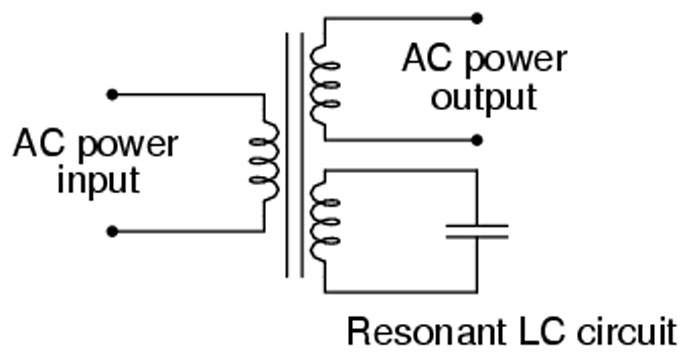
A ferroresonant power supply uses a transformer with a secondary winding operating near magnetic saturation. A capacitor connected to a dedicated resonant winding creates a tuned circuit.
As the input voltage changes, the saturated magnetic section of the transformer helps restrict changes in magnetic flux. This allows the secondary output voltage to remain comparatively stable over a specified input and load range.

Figure 1: Simplified ferroresonant transformer showing the AC input, regulated AC output and resonant LC circuit.
The transformer therefore performs several functions:
- Voltage conversion
- Input-to-output isolation
- Output voltage regulation
- Filtering of some mains disturbances
- Short-duration energy storage
The regulated AC output may then be rectified and filtered when a DC output is required.
Ferroresonance and Magnetic Saturation
Ferroresonance is the interaction between the transformer's nonlinear magnetic inductance and the connected capacitor.
Once the regulating section approaches saturation, larger changes in input voltage produce smaller changes in magnetic flux. This helps stabilise the voltage induced in the output winding.
The resonant capacitor is essential to this operation. Its value must be matched to the transformer design and mains frequency for the supply to regulate correctly.
Constant Voltage Transformer Regulation
A ferroresonant transformer is often described as a constant voltage transformer (CVT) because it can maintain a reasonably consistent output without electronic feedback circuitry.
However, the output is not perfectly constant. Regulation depends on factors such as:
- Input voltage range
- Load level
- Mains frequency
- Transformer design
- Capacitor condition
- Ambient temperature
The manufacturer's specified operating range should always be checked before selecting the supply.
Advantages of Ferroresonant Power Supplies
Ferroresonant power supplies offer several useful characteristics:
- Robust construction
- Galvanic isolation
- Built-in voltage regulation
- Good resistance to mains voltage fluctuations
- Suppression of some voltage spikes and electrical noise
- High short-circuit tolerance
- No complex electronic regulation circuit
- Short hold-up capability during brief input disturbances
These features can make them suitable for electrically noisy or unreliable supply environments.
Limitations of Ferroresonant Power Supplies
Compared with modern switch mode power supplies, ferroresonant units are generally:
- Larger and heavier
- Less energy-efficient
- More likely to generate audible humming
- Sensitive to mains frequency variation
- Capable of producing additional heat
- Limited in their response to some nonlinear loads
- Less suitable where compact size and low standby consumption are priorities
Output waveform distortion may also be a consideration, particularly when supplying sensitive electronic loads.
Ferroresonant Power Supply vs Switch Mode Power Supply
A ferroresonant power supply uses magnetic saturation and resonance to regulate its output. A switch mode power supply uses high-frequency semiconductor switching and electronic feedback.
Ferroresonant power supply
- Simple and rugged
- Large low-frequency transformer
- Built-in isolation and power conditioning
- Heavy and comparatively inefficient
- Well suited to certain harsh electrical environments
Switch mode power supply
- Compact and lightweight
- Higher efficiency
- Wider range of functions and output options
- Faster regulation
- More complex electronic design
The best option depends on the load, environment, efficiency requirement and available installation space.
Ferroresonant Power Supply vs Linear Power Supply
Both designs may use mains-frequency transformers, but a conventional linear power supply normally relies on rectification and an electronic linear regulator to stabilise its DC output.
A ferroresonant supply instead uses the transformer's magnetic saturation characteristics and a resonant capacitor to regulate the voltage before, or as part of, the conversion process.
Power Conditioning
A ferroresonant transformer can provide some protection against:
- Input voltage variation
- Short-duration mains disturbances
- Electrical noise
- Voltage spikes
- Brief interruptions
Its energy storage capability may allow the output to continue briefly during a very short input interruption. However, it is not a replacement for an uninterruptible power supply where extended backup power is required.
Typical Applications
Ferroresonant power supplies have historically been used in:
- Industrial control equipment
- Telecommunications systems
- Security and alarm systems
- Battery charging equipment
- Process control systems
- Instrumentation
- Mains voltage stabilisers
- Equipment operating from unstable utility supplies
They remain useful where ruggedness and power conditioning are more important than size, weight or maximum efficiency.
Selecting a Ferroresonant Power Supply
Important selection factors include:
- Input voltage and frequency
- Required AC or DC output
- Continuous load power
- Output voltage tolerance
- Load type
- Efficiency
- Physical size and weight
- Audible noise restrictions
- Ambient operating temperature
The load should also be checked for compatibility, as strongly nonlinear or highly capacitive loads may affect regulation and waveform quality.
People Also Ask
What does ferroresonant mean?
Ferroresonant describes a circuit that uses the nonlinear magnetic behaviour of a transformer together with a capacitor to create resonance and stabilise the output voltage.
What is a ferroresonant power supply used for?
It is used where voltage regulation, isolation and resistance to mains disturbances are required, particularly in industrial, security and control applications.
Is a ferroresonant transformer the same as a constant voltage transformer?
The terms are commonly used interchangeably. A constant voltage transformer uses ferroresonance and magnetic saturation to regulate its output voltage.
What is the difference between a ferroresonant power supply and a UPS?
A ferroresonant supply can ride through very brief disturbances using stored magnetic and electrical energy, but a UPS uses batteries or another energy store to provide longer backup operation.
Are ferroresonant power supplies efficient?
They are generally less efficient than modern switch mode power supplies because they use a large mains-frequency transformer and operate part of the magnetic core near saturation.
Speak to a technical expert!
Have a question or request? Click below to contact us, and our team will be happy to help.