Frequency Filter
What is a Frequency Filter?
A frequency filter is an electronic circuit or device that allows selected frequencies to pass while reducing or blocking frequencies outside the required range. Frequency filters are used to separate useful signals from unwanted noise, interference or harmonic content.
They are widely used in power supplies, audio equipment, communication systems, control circuits and electromagnetic interference filtering.
The behaviour of a filter is described by its frequency response, which shows how strongly different frequencies are passed or attenuated.
How a Frequency Filter Works
A frequency filter uses components whose electrical behaviour changes with frequency. These commonly include:
- Resistors
- Capacitors
- Inductors
- Operational amplifiers
- Digital signal processors
Capacitors and inductors are especially useful because their impedance changes as the signal frequency changes.
A capacitor generally offers greater opposition to low-frequency signals and less opposition to high-frequency signals. An inductor behaves in the opposite way, offering increasing opposition as frequency rises.
By arranging these components in different circuit configurations, designers can control which frequencies pass through the circuit.
Types of Frequency Filter
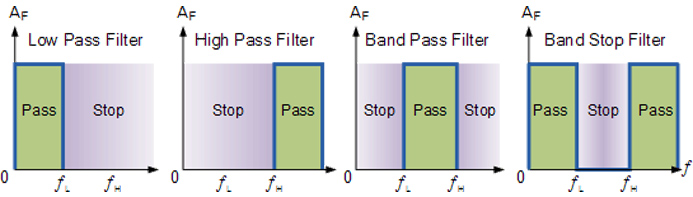
Frequency filters are generally classified according to the range of frequencies they allow to pass.
Low-Pass Filter
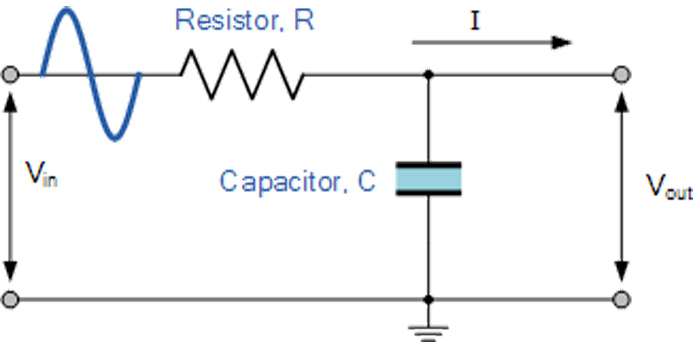
A low-pass filter allows frequencies below a selected cut-off frequency to pass while attenuating higher frequencies.
Low-pass filters are commonly used to:
- Smooth power supply outputs
- Reduce switching noise
- Remove high-frequency interference
- Recover low-frequency signals
- Reduce ripple in rectified DC outputs
In a power supply, an output capacitor and inductor may form a low-pass filter that reduces high-frequency switching components while allowing the required DC output to remain.
High-Pass Filter
A high-pass filter allows frequencies above its cut-off frequency to pass while reducing lower-frequency signals and DC.
High-pass filters are commonly used for:
- Blocking DC offsets
- Signal coupling between circuit stages
- Removing low-frequency noise
- Audio signal processing
A coupling capacitor is a common example of a simple high-pass filter.
Band-Pass Filter
A band-pass filter allows a selected range of frequencies to pass while attenuating frequencies above and below that range.
It is commonly used in:
- Radio receivers
- Communication systems
- Audio equipment
- Sensors
- Measurement instruments
The range between the lower and upper cut-off frequencies is known as the filter’s bandwidth.
Band-Stop Filter
A band-stop filter blocks a selected range of frequencies while allowing frequencies below and above that range to pass.
A narrow band-stop filter is often called a notch filter.
These filters are useful for removing specific sources of interference, such as:
- 50Hz or 60Hz mains hum
- A known switching frequency
- Radio-frequency interference
- Unwanted resonant frequencies
Cut-Off Frequency
The cut-off frequency is the point where the filter begins to significantly attenuate the signal.
For many basic filters, this is defined as the frequency where the output amplitude falls to approximately 70.7% of its passband value, corresponding to a power reduction of 3dB.
A filter may have one cut-off frequency or two:
- Low-pass and high-pass filters normally have one
- Band-pass and band-stop filters normally have lower and upper cut-off frequencies
The cut-off point does not represent an immediate boundary. Real filters change gradually between the passband and stopband.
Passband, Transition Band and Stopband
A filter’s frequency response can be divided into three main regions:
Passband
The range of frequencies allowed to pass with minimal attenuation.
Transition Band
The range over which the filter response changes from passing to attenuating the signal.
Stopband
The range of frequencies that the filter substantially reduces or blocks.
The steepness of the transition between the passband and stopband depends on the filter design and order.
Passive Frequency Filters
Passive filters use components such as:
- Resistors
- Capacitors
- Inductors
They do not require an additional power source and cannot amplify the signal.
Passive filters are widely used in:
- Power supply inputs and outputs
- EMI filters
- Audio crossover circuits
- High-current applications
Their performance depends on the connected source and load impedances.
Active Frequency Filters
Active filters combine resistors and capacitors with powered components such as operational amplifiers or transistors.
They can provide:
- Signal amplification
- Improved isolation between circuit stages
- More accurate frequency response
- Easier control of filter characteristics
Active filters are commonly used in low-power signal processing but are generally unsuitable for filtering high-power supply outputs directly.
Digital Frequency Filters
Digital filters process sampled signals using mathematical algorithms rather than relying entirely on physical capacitors and inductors.
They are used in:
- Digital communication systems
- Audio processing
- Instrumentation
- Embedded control systems
- Software-defined systems
Digital filters can be highly accurate and easily reconfigured, but the signal must first be converted into digital data.
Frequency Filters in Power Supplies
Power supplies use filters at several stages.
Input filters
Input filters reduce electromagnetic interference entering or leaving the power supply through the mains connection.
Rectifier filters
Capacitors and inductors smooth the pulsating DC produced by a rectifier.
Output filters
Output filters reduce switching ripple and high-frequency noise before power reaches the load.
Control-loop filters
Filters may also shape the response of feedback and control circuits to maintain stability and improve transient performance.
Frequency Filters and EMI
Frequency filters are essential for controlling conducted electromagnetic interference.
A power supply may use:
- Differential-mode inductors
- Common-mode chokes
- X capacitors
- Y capacitors
- Ferrite components
These components attenuate unwanted frequency content while allowing the normal operating current to pass.
The filter must be designed for the type of interference, frequency range, voltage and current involved.
Filter Order
Filter order describes the number of reactive stages contributing to the filter response.
A higher-order filter generally provides:
- A steeper transition
- Greater attenuation outside the passband
- Better frequency separation
However, higher-order filters are also more complex and may introduce additional phase shift, component tolerances and stability considerations.
Why Frequency Filters Matter
Frequency filters help electronic systems:
- Reduce electrical noise
- Improve signal quality
- Meet EMC requirements
- Stabilise power supply outputs
- Prevent interference between circuits
- Protect sensitive equipment
- Separate wanted signals from unwanted frequencies
Selecting the correct filter requires understanding the signal, interference source, cut-off frequency, load and required attenuation.
People Also Ask
What does a frequency filter do?
A frequency filter allows a selected range of frequencies to pass while attenuating frequencies that are unwanted or outside the required operating range.
What are the four main types of frequency filter?
The four main types are low-pass, high-pass, band-pass and band-stop filters.
What is the cut-off frequency of a filter?
The cut-off frequency is the point where a filter begins significantly reducing the signal, commonly defined at a 3dB reduction in power.
What is the difference between a passive and active filter?
A passive filter uses resistors, capacitors and inductors without external power. An active filter uses powered components such as operational amplifiers and can provide gain or circuit isolation.
How are frequency filters used in power supplies?
Power supplies use frequency filters to reduce mains interference, smooth rectified voltage, suppress switching noise and minimise output ripple.
Speak to a technical expert!
Have a question or request? Click below to contact us, and our team will be happy to help.