Direct Current
What is Direct Current (DC)?
Direct Current (DC) is an electrical current that flows in one direction continuously. Unlike alternating current (AC), which repeatedly changes direction, DC maintains a constant polarity over time.
DC power is widely used in electronics, batteries, LED lighting, telecommunications and modern low-voltage systems.
How Direct Current Works
In a DC circuit:
- Electrons move in a single direction
- Voltage polarity remains constant
- Current flows steadily over time
Conventional current flow is considered to move:
- From positive to negative
while electrons physically move:
- From negative to positive
This continuous one-way flow makes DC ideal for powering electronic circuits and sensitive components.
Direct Current Waveform
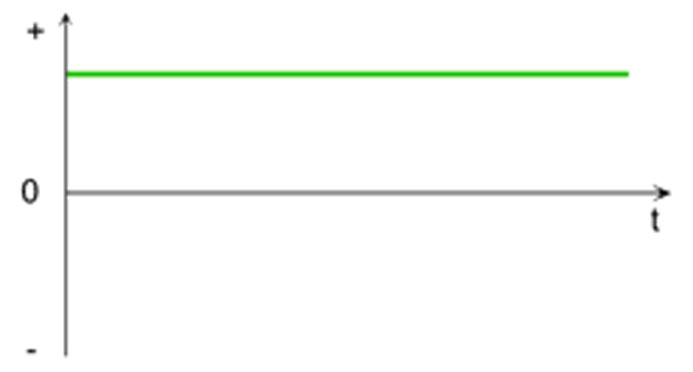
The graph shows a typical direct current waveform, where the voltage remains constant over time instead of alternating between positive and negative values.
Direct Current vs Alternating Current
The main difference between DC and AC is the direction of current flow.
Direct Current (DC)
- Flows in one direction
- Constant polarity
- Common in electronics and battery systems
Alternating Current (AC)
- Reverses direction periodically
- Used for mains electricity distribution
- Typically operates at 50Hz or 60Hz
Sources of Direct Current
Common DC sources include:
- Batteries
- Solar panels
- DC generators
- AC-DC power supplies
- Thermocouples
Many modern electronic devices rely on DC power internally even when powered from AC mains.
AC to DC Conversion
Because mains electricity is usually AC, most electronic systems use power supplies or rectifiers to convert AC into DC.
Examples include:
- Laptop adapters
- Phone chargers
- LED drivers
- Industrial power supplies
These systems convert high-voltage AC into regulated low-voltage DC suitable for electronics.
Common DC Voltage Levels
Typical DC voltage levels include:
- 1.2V
- 1.5V
- 3.3V
- 5V
- 12V
- 24V
- 48V
Different equipment requires different voltage and current levels depending on its design.
Advantages of Direct Current
DC power offers several advantages:
- Efficient for electronic circuits
- Suitable for battery storage systems
- Stable voltage for sensitive devices
- Lower shock risk at low voltages
- Compatible with renewable energy systems such as solar
DC is also increasingly important in electric vehicles and energy storage systems.
Disadvantages of Direct Current
DC systems can also present challenges:
- High-current systems require larger cables
- Voltage conversion can be more complex at high power
- Incorrect cable sizing can increase fire risk
- Long-distance transmission is traditionally less efficient without conversion technology
Applications of Direct Current
DC is used in:
- Computers and laptops
- Smartphones and tablets
- LED lighting systems
- Telecommunications equipment
- Industrial control systems
- Electric vehicles
- Battery-powered devices
Although buildings receive AC mains power, most modern electronics internally operate using DC.
Direct Current and Batteries
Batteries are one of the most common DC sources. Rechargeable systems use chargers to replenish battery energy by converting AC mains into DC charging voltage.
This allows:
- Portable operation
- Backup power functionality
- Energy storage capability
People Also Ask
What is direct current?
Direct current (DC) is electrical current that flows continuously in one direction.
What is the difference between AC and DC?
DC flows in one direction, while AC repeatedly changes direction over time.
Where is DC power used?
DC is used in electronics, batteries, LED lighting, electric vehicles and industrial control systems.
Why do electronics use DC?
Electronic components require stable voltage and polarity, which DC power provides.
How is DC created from AC?
Power supplies and rectifiers convert alternating current into direct current for electronic devices.
Speak to a technical expert!
Have a question or request? Click below to contact us, and our team will be happy to help.